
· by Michael Blair, Nashville's Contractor
Most people searching for a site grading plan in Nashville have a lot, a house design and a question nobody has answered yet: does the dirt work need its own permit? On a lot of Davidson County parcels it does, and that permit comes from a different office than the building permit, on its own schedule, with erosion controls that have to be in the ground and inspected before the grading permit is even issued. Grading, pads and drainage are the first work on our site work and hardscapes jobs, so this is the question we sort out before anything else on a new house.
What counts as grading, and who regulates it here
Grading is broader than leveling a pad. Metro Water Services’ Stormwater Division, on its page about who needs a grading permit, describes grading as changing the existing elevations of a site, removing its ground cover, or relocating a watercourse, and names stripping, cutting, filling and stockpiling as the ways it happens. Clearing the brush and topsoil off a wooded lot is grading under that definition, even before a machine moves any fill.
Inside Metro Nashville and Davidson County, the grading permit is issued by that Stormwater Division, not by the Codes office that handles the house itself. The building permit, its inspections and the order they come in are covered in our post on how permits and inspections work in Nashville; the grading permit runs alongside it, and on most new houses the ground work comes first.
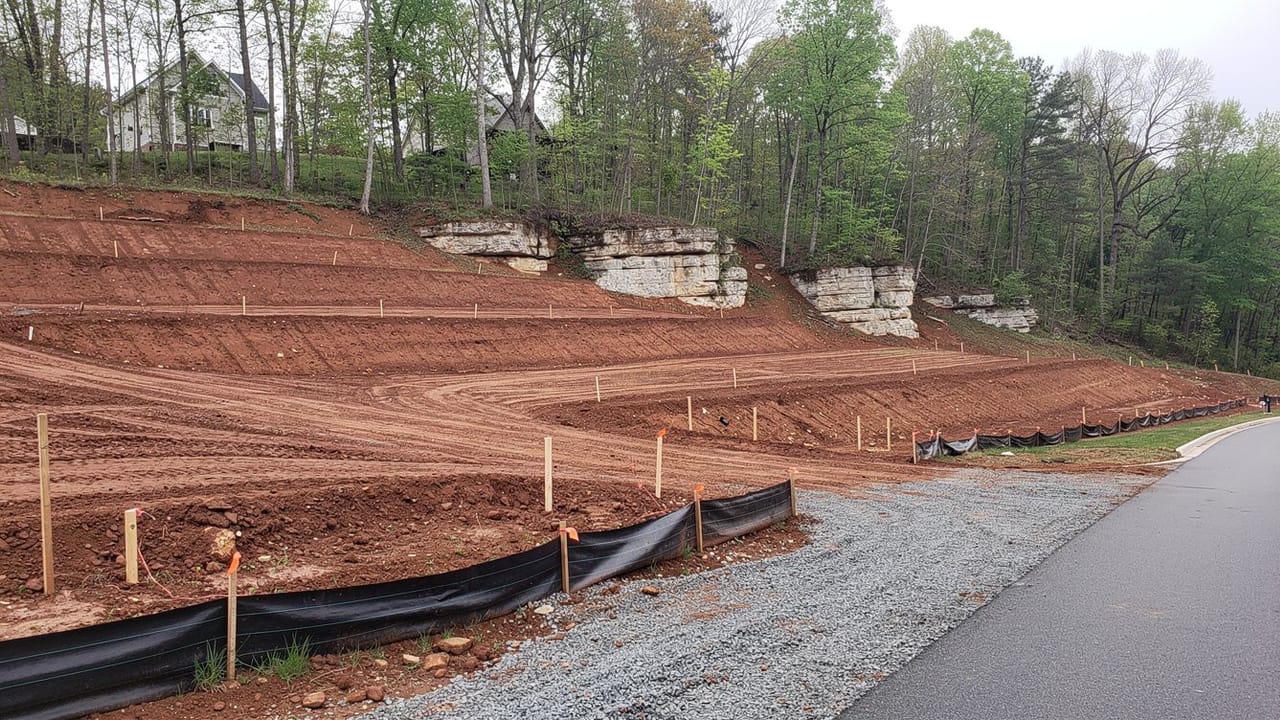
A grading plan is the drawing that answers Stormwater’s questions about a lot: where the ground is now, where it will be when we are done, where the house pad and driveway sit, which way the water runs off the finished site, and where the silt fence, construction entrance and other erosion controls go while the soil is bare. On a hillside lot in West Nashville or a flat one near a creek in Antioch, it is the same set of questions with very different answers.
When a lot needs a Metro grading permit
The Stormwater Division’s page lists what does not need a permit, and it is worth reading closely because the thresholds are smaller than people expect. Fill less than five feet deep at its deepest point from natural ground, outside the 100-year floodplain, and work that does not move more than 100 cubic yards in total, are listed as not requiring a permit, but that category does not cover a disturbance larger than 10,000 square feet. Separately, Metro’s Build Responsibly page says a grading permit is required for all land-disturbing activity over 10,000 square feet and that the application has to be made before construction starts.
Those two pages are worded differently, and how they line up on a particular lot is a question we put to MWS Stormwater rather than answer from a summary. A new house on a typical infill lot can clear, cut and fill more than 10,000 square feet once the driveway, the pad, the yard and the spoil pile are counted, and a sloped lot can move well past 100 cubic yards before the footings are dug. We measure the disturbed area and the cut and fill from the plan, then confirm with Stormwater which side of the line the job falls on.
The Stormwater page also lists exemptions, set out below. They do not apply in a designated floodplain, exempt work still has to comply with the stormwater regulations, and Metro can revoke an exemption over a violation.
- Maintenance or landscaping on an existing developed lot, where no more than 10,000 square feet is affected or stripped at any one time
- A grade change of no more than 18 inches at any point
- Work that moves no more than 100 cubic yards
- Finish grading, or excavation for the basement and footings of a single-family home or duplex
- Accessory structures for a single-family home or duplex built under a valid building permit, where erosion is handled properly
The floodplain changes the whole plan
Davidson County has a lot of land near water, from the Cumberland to Mill Creek, Richland Creek and the Harpeth, and the floodplain is where the exemptions stop. Metro’s Build Responsibly guidance sets out the rules that follow from it: fill placed in the floodplain has to be offset with an equal volume of cut, a building in the floodplain has its lowest finished floor four feet above the 1-percent-annual-chance flood elevation, and development in the floodway itself is prohibited apart from a few exceptions.
For a grading plan, that means a lot partly in the floodplain cannot simply be built up to get the house out of the water. Every yard of fill brought in below the flood elevation has to be matched by a yard dug out somewhere else in it, and the finished floor height drives the foundation design, the steps to the door and the slope of the driveway. Those are decisions to make on paper, which is why we look at the flood maps before a custom home is drawn, not after the lot is cleared.
The review order, and the state permit on larger sites
Metro’s stormwater review process runs in a fixed order: plan submittal, plan review and approval, a pre-construction meeting, installation of the erosion prevention and sediment controls, an initial inspection of those controls, and only then issuance of the grading permit. Routine erosion-control and MS4 inspections follow during the work, then an as-built submittal and a final inspection and approval.
The order matters for the schedule. The silt fence, the construction entrance and whatever else the plan calls for go in first and have to pass inspection before the permit is issued, so the first site visit after approval is installing controls, not digging. On Nashville clay that holds water for days after a rain, a lot that has been stripped and left without controls is the lot that sends mud into the street and the storm drain, and that is what those inspections are there to catch.
A larger site adds a state layer on top of Metro’s. The Tennessee Department of Environment and Conservation’s construction stormwater permit page says coverage applies to operators of sites where clearing, grading or excavation disturbs one acre or more, and to smaller sites that are part of a larger common plan of development or sale. The operator files a notice of intent electronically through MyTDEC Forms, the Division issues a notice of coverage on a complete filing, and primary operators prepare a stormwater pollution prevention plan. The same page says a new general permit is in effect from October 1, 2026, running through September 30, 2031, with new forms available around that date.
A single house on an ordinary city lot usually stays under an acre. A home on acreage, or a house with a long drive, a detached shop and a pad for a barn, can pass it. If your project includes an outbuilding, our post on permits for a detached garage or workshop covers the building side, and the Nashville page covers how we work in Davidson County. When you ask us for an estimate, send the parcel address and the house plan if you have one, and the grading question is the first thing we run down.
Sources
- Metro Water Services, Stormwater Division: Who Needs a Grading Permit — Definition of grading, the no-permit thresholds and the listed exemptions, and their limits in the floodplain.
- Metro Water Services: Build Responsibly — Grading permit for land disturbance over 10,000 square feet; floodplain fill, finished-floor and floodway rules.
- Metro Water Services: Stormwater Review — The plan review sequence, from submittal to final inspection.
- TDEC Division of Water Resources: Construction Stormwater Permit — State coverage for one acre or more of disturbance, the notice of intent, the SWPPP and the 2026 general permit dates.