
· by Michael Blair, Nashville's Contractor
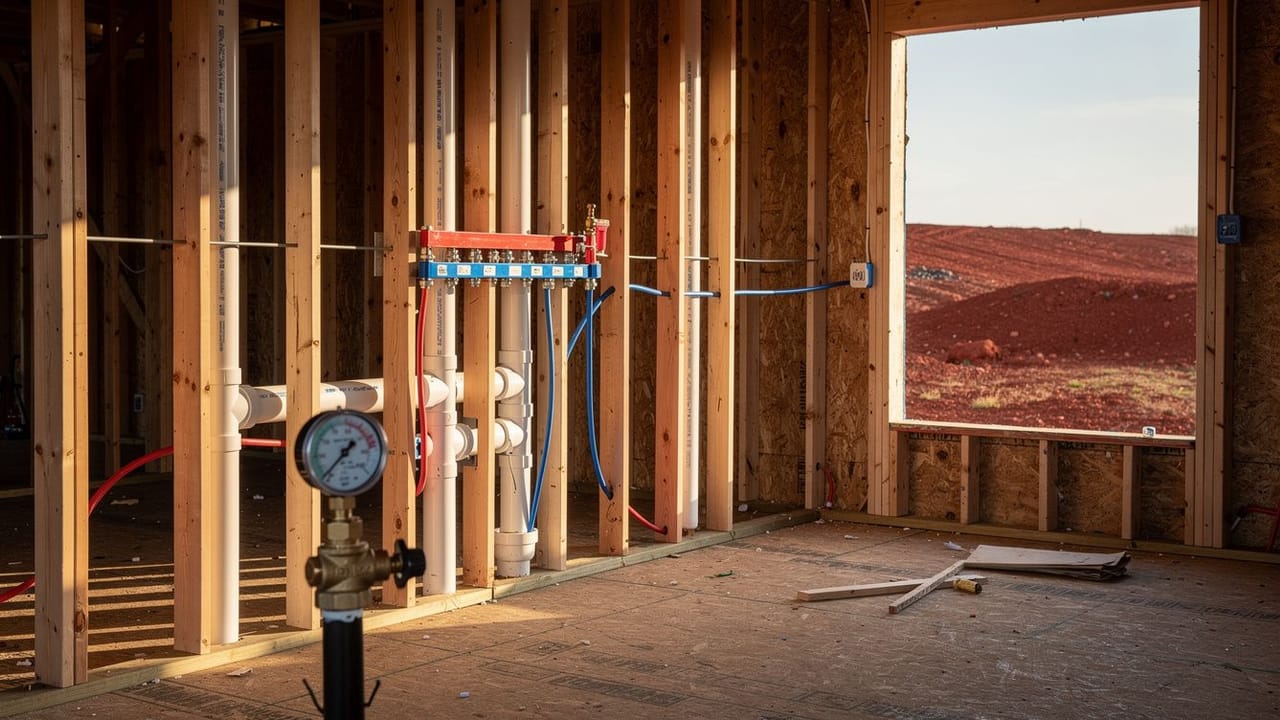
On a new house, the plumbing rough-in is the stage when every drain, vent and supply line is in the walls and floors but nothing is covered yet. It is also the stage when the inspector arrives to watch the system be tested, and the house cannot move on to insulation and drywall until it passes. Owners often hear “we passed rough-in” without knowing what was checked. Our permits and inspections post covers the sequence for the whole house; this one stays on the plumbing test, because it is the one most often misunderstood and the one that holds up the most trades behind it. It is part of every house we build on our custom homes side.
What does the plumbing rough-in inspection test?
It tests whether the drain, waste and vent piping and the water supply piping are tight, by putting them under water, air or vacuum and watching for a drop or a leak. Metro Nashville’s adopted codes list shows the 2024 International Residential Code and the 2024 International Plumbing Code in force under BL2025-898. In the UpCodes copy of the Nashville edition of the 2024 IRC, Section P2503, the rough drain piping is tested when the rough piping is complete, by water, by air for piping that is not plastic, or by vacuum for plastic, and it has to show no leakage.
The water test fills the section being tested to at least 10 feet above its highest fitting connection, or to the top of the system, and holds it for 15 minutes; the inspector looks for leaks at every joint. The air test holds 5 psi on a gauge for 15 minutes without pumping more in, and the vacuum test holds minus 5 psi for the same time. Because the test is read by eye and by gauge, the pipe has to be visible, which is why insulation and drywall wait.
Did the drain test change between code editions?
Yes: the water test needs 5 feet of head under the 2018 IRC and 10 feet under the 2021 and 2024 editions, so the answer depends on which edition the jurisdiction has adopted. The 2018 IRC, Section P2503.5.1, as listed for Tennessee on UpCodes, sets the water test at not less than 5 feet above the highest fitting, with no vacuum option. The ICC’s own Significant Changes to the 2021 IRC summary for P2503.5.1 records the head rising from 5 feet to 10 feet and vacuum testing becoming allowed for plastic pipe.
Inside Metro, the 2024 edition applies, so plan on 10 feet. Outside Metro, ask that city or county’s codes office which edition it enforces before the plumber sets up the test. A plumber used to one number can stand up a test that is short of what the inspector expects, and the fix is a retest on another day.
How are the water lines and the shower pan tested?
The supply piping is tested at the water pressure it will work under, or with air at not less than 50 psi for piping that is not plastic, for 15 minutes. In Section P2503 of the 2024 IRC, Nashville edition, that test uses potable water, with an exception that allows a compressed-gas test on PEX only where the PEX maker authorizes it. If your house is plumbed in PEX, the maker’s instructions decide whether air is allowed at all.
A tiled shower built on a liner gets its own test before the tile goes on. The 2021 International Plumbing Code, Section 312, on UpCodes, calls for the liner to be filled with water at least 2 inches deep at the threshold, and the same section says plastic piping is not to be tested with air. Later, once fixtures are set and traps are filled, the final plumbing test has each fixture filled and drained to prove the traps and connections hold.
Getting a house ready for the plumbing inspector
The permit holder calls for the inspection and supplies the water, the gauges, the test plugs and the labor; the inspector watches. Metro’s requesting an inspection page says registered licensed contractors schedule through E-Permits and everyone else calls with the permit number on weekdays. On our houses nothing gets covered, not the walls, not the under-slab lines, not the shower pans, until the inspector has watched the test hold.
If you are building in Nashville or nearby and want to know where your house stands in the inspection sequence, or want the rough-in on your schedule explained before it happens, ask us and we will walk you through it.
- Drain, waste and vent: water to the edition’s head height, or air or vacuum, for 15 minutes
- Water supply: working pressure, or air on non-plastic pipe, for 15 minutes
- Shower liner: filled at least 2 inches deep at the threshold
- Nothing covered until the inspector has signed off
Sources
- Metro Nashville Codes, Adopted Codes List — BL2025-898 and the 2024 International Residential and Plumbing Codes in force in Metro
- 2024 International Residential Code, Nashville edition, Section P2503 (UpCodes) — Rough drain test by water to 10 feet, air at 5 psi or vacuum, 15 minutes; water supply test; PEX compressed-gas exception; final test
- 2018 International Residential Code, Section P2503.5.1, Tennessee listing (UpCodes) — The earlier 5-foot water test and no vacuum option
- ICC, Significant Changes to the IRC 2021, P2503.5.1 — Head for the drain water test raised from 5 to 10 feet; vacuum testing allowed for plastic pipe
- 2021 International Plumbing Code, Section 312 (UpCodes) — Plastic piping not air-tested; the permit holder supplies equipment and labor; shower liner filled at least 2 inches at the threshold
- Metro Nashville Codes, Requesting an Inspection — Scheduling through E-Permits for registered licensed contractors, or by phone with the permit number on weekdays
FAQ
The Plumbing Rough-In Inspection on a New House — questions
How do you prepare for a rough plumbing inspection?
Finish all the rough drain, vent and supply piping, cap or plug the openings, and set up the test before the inspector arrives: water to the required height, or air or vacuum on a gauge. Leave every pipe visible, have the permit number ready, and do not insulate or drywall anything yet.
How high does the water have to go in a drain test?
Under the 2021 and 2024 International Residential Code, the section being tested is filled to at least 10 feet above its highest fitting and held 15 minutes. The 2018 edition required 5 feet. Metro Nashville runs the 2024 code, so plan on 10 feet there and check the edition elsewhere.
Can plastic drain pipes be air tested?
Under the 2021 International Plumbing Code, plastic piping is not tested with air. The 2024 International Residential Code, which Metro Nashville has adopted, allows plastic drain piping to be tested with water or by vacuum, and keeps the air test for piping that is not plastic. Ask the inspector before setting up anything else.
What is a plumbing rough-in?
It is the stage when the drain, waste, vent and water supply piping are installed in the walls, floors and slab, but before fixtures are set or anything is covered. The rough-in inspection tests that piping for leaks, and insulation and drywall wait until it passes.
How is a water supply line tested for inspection?
The water supply piping is held at its working water pressure, or with air at not less than 50 psi on piping that is not plastic, for 15 minutes without leaking. PEX can be tested with compressed gas only where its manufacturer allows it, so check the maker’s instructions first.